Art Practice | Current
My current practice explores social and cultural positionality and the complexities of my own intersectional identities. This reflexive practice includes considerations of gender
identity from feminist perspectives, sexuality and social expectations, and my identity as Romani, including my relationship to family, culture and ethnicity, and experiences of forced assimilation, racism and the complexities of 'belonging'.
Roaming Britain: Inside/Outside Photographic Essay.
Co-Curated display will be shown at RIBA/Tate Liverpool 18th-30th of June 2026
Through the photo essay Inside / Outside, I explore ideas of innovative adaptation and use of materials by those in my community and family, to build structures that feel to literally represent and in addition symbolise, self-led and self-sufficient conceptions of containment. The body of work explores and records the resilience of the Romani community in their ability to adapt to discrimination and forced assimilation. This is shown through my juxtaposing of what I consider to be two types of architectural structures that vary greatly in scale. Similarities between these structures can be found in the motivations behind their construction, these being a subversion of circumstances arising from race-based trauma and experiences of discrimination, to explore and enact creative solutions. The first type of these structures are boxes and small objects made from matchsticks by my Dad during his time spent in prison, then gifted to family members. I make direct links with her father’s lived experiences of racism and the marginalisation he experienced in his lifetime, and his subsequent incarceration. During these periods of incarceration, he learned carpentry skills and made many of the boxes and objects I have photographed.
I parallel these photographs with that of another type of containing structure, often referred to on caravan sites of Romani people as the sheds. These are hand-built structures or adaptations to living facilities on each plot, that are built alongside caravans and trailers, which are primarily used solely for sleeping. In addition, the photo essay shows examples of extra living, work or storage spaces, always hand built by the family often with innovative and untrained use of skill, materials and found objects. These structures are built to contain family life, used for cooking, working within, storing tools, or housing pets. These structures vary, sometimes being quite rudimentary in nature, to incredibly polished, professionally built and comfortable living spaces that incorporate the outside / inside nature of traditional Romani life, yet in the context of adapting to contemporary restraints on traditional cultural practices. For me, the structures and their raw beauty symbolise community led ways to maintain a sense of traditional, cultural and personal power and identity.


By Appointment Only
Group Exhibition / co-curator
Museum London
Up until the 90s in England, you could often see signs in pubs and restaurants reading “No travellers or Gypsies allowed.” This gradually changed to “Travellers by Appointment Only,” a slightly less explicit way to exclude Romani people. The words remain a powerful symbol of the oppression that the Romani Gypsy community continue to face in today’s society. Museums can also be seen as unwelcoming and exclusionary spaces. This exhibition invites us all to further understanding and build connection. By Appointment Only showcases the work of three English Romani artists, who share their identity and experiences in the tradition of Romani visual activism. Their artworks connect the past and the present, challenge stereotypes, and highlight the contribution of the Romani Gypsy community to British society with a focus on trade and industry.


Sugar Coated (2025) Mixed Media Installation
The installation comprises of several components that act as a conceptual narrative surrounding my relationship with my ethnicity as Romani and my father, who passed away in 2019. The work explores this through responding to and evoking memories regarding one of my father’s trades, as a car tyre dealer and fitter, with this work being quite commonplace in Romani communities, and requiring him to regularly visit London from his home in Berkshire, to sell and trade in stock. The installation also takes inspiration from the former use of the Docklands Museum of London Building which was in part a sugar storage warehouse. Knowledge of this former use of the building triggered vivid memories for me surrounding my father’s work as tyre trader. I have incorporated 3D printed castes of my father’s hands, that were taken in the weeks before he passed away. The sugar bowls are Royal Crown Derby Imari, which are popular and widely collected within Romani communities.
“During my early childhood my Dad would often not only use the entire side of our house to store hundreds of tyres he would be trading in, but he would also use our small kitchen to cut tyre tread. This would result in the entire house smelling of burnt rubber and thousands of zigzagged lengths of trye tread being discarded on the kitchen floor. At the end of his working day his hands would be covered in tyre black. He would often ask me as a child to stand on a stool to reach his hands in the sink and following squeezing copious amounts of washing up liquid into his palms he would then ask me to pour sugar in small piles into each hand, so he could then rub his hands together and use the gritty substance to properly remove the tyre black. This used to feel like an important and intimate ritual to me where I felt close to my Dad and helpful, as an active part of the way our family earned money, something that was always an openly discussed ongoing effort, surrounded by a sense of uncertainty and anxiety, yet also celebration and joy if things felt financially stable for a while. As a child these collective concerns felt difficult to know, yet equally they felt to centre and unite my family, where dynamics often felt fractured and troubled. I now know just how significant racialised trauma and trans and intergenerationally transmitted traumas, racism and exclusion were, in this shared holding of uncertainty surrounding economic stability.”


Held Tradderly
Solo Exhibition
Art ByPass Gallery
The exhibition Held Tradderly explored on personal, community and cultural levels the significance of death rituals within the Romani Gypsy community. The Romani people are genetically distinct from other populations and the initial out-migration of the Romani diaspora from India has been traced to the sixth century with paths through central Asia, the Caucaus and the Middle East where a divergence of Eastern and Western branches began in the twelfth century. Tradderly means carefully in Romanichal, the language still spoken by English Romani communities, although now acknowledged as an endangered language.
In this body of work I explore my Romani ethnicity, along with other intersecting identities and document through sculptural and photographic response, the transformative, painful yet often beautiful process of managing the end of life care and then death rituals and the funerals of both my parents and a beloved Aunt.


The Pedestal Project (2017)
Photography Mia Hawk
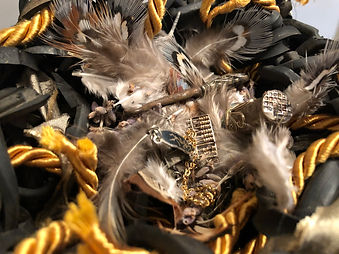
A self-portrait project utilising costume, props and family and cultural narratives that hold significance for me. The exploring of costume and makeup becomes representative of identity formation, photographed as a visual narrative and cultural archive. This process was paralleled by my sharing with Mia a verbal narrative of life experience and desires to be ‘all of myself at once’ in part in response to the necessity from those within Romani communities to hide our true ethnicity if we can, to avoid racism. In this first portrait from the series, title Brazen Chavi, I wear pheasant skins gifted to me by my Dad from birds he had killed to eat, which may in part represent the tensions between middle-class appearance and working-class origins. The rawness of the attempted integration seems to be illustrated in the bloodied attachment / detachment of the skins. The theatrical makeup may represent war paint and the absurd, commenting on my pale skin and feelings of alienation and difference felt from within and outside of my community and family. As well as symbolising disguise as a form of self-protection. The word “slut” is scrawled across my chest responding to patriarchal shaming that exists for women within my community and beyond, and also comments on the complexities of sexuality. Trinkets inherited from family adorn my costume, I am about to eat caviar from an over-sized silver spoon.


Current Practice
My art practice incorporates my use of photography, self portraiture, film and found object sculpture. Combinations of which I often play with and reconfigure to exhibit as multi component installations or photo essays that explore the many faceted, intersectional and ever shifting narratives associated with identity formation and sense of self in social, political and personal contexts.


The Scrying Game 1: Gub (2025)
The series explores my Romani Gypsy ethnicity and familial relationships in the context of marginalisation and race related oppression and trauma. The body of the piece takes inspiration from my Grandmothers crystal ball, used to tell fortunes for money and for family members, while travelling, inherited now by my cousin. The replica ball contains one of many drawings I created as a child, which were included in many letters written to my Dad by my Mum, during times he had spent in prison.


Deathless Death (2024)
A sculpture made from mixed media materials which are primarily personal belongings or inherited family possessions. The piece explores ideas of patriarchal and matriarchal roles in Romani Gypsy communities and the impact of parenting, family and community on the development of self.


Rokka Nixi Photographic Essay (2022)
Rokka Nix means say nothing in Romanichal, something my Dad would often say to me growing up, in Romani Jib, if outsiders were asking questions he didn't want answered with honesty. The photographic essay was commissioned by The Romani Arts Company in 2022.
As an act of ritual, an attempt to externalise and symbolise my pain and to communicate what had been mostly unspoken with my Dad, I chose to build each little sculpture on his casket, in the hours before his Sitting Up (a Romani death ritual much like a wake) and documented this process. I also photographed other parts of his Sitting Up and the burning of some of his possessions to go with him. These traditional Romani rituals around death and loss felt incredibly important and containing.




Exhibitions and Work Installation
Some works shown in group exhibitions are not mine.


Community Engagement, Workshops, Art Therapy Workshops, Artist Mentoring, Q&As and Artist Talks.
I enjoy running bespoke workshops or artists mentoring sessions as well as providing artists talks. All responding to a projects community engagement needs which I see as an extension of my art practice and a way of informing my ongoing making. I have worked with groups of children and adults and have enjoyed working with Romani, Roma and Romani diaspora adults and children who have settled in the UK. I see my work with communities, artists talks and Q&As as both informing my ongoing practice and as an extension of my anti oppression and anti racism activism, challenging stereotypes and building understanding of difference between communities.


